

SDC
Rolland's Damselfish
Rolland's Damselfish
Couldn't load pickup availability
Free overnight shipping at $169+. $12.50 packaging applies. Destination restrictions apply.
Shipping details Day-of-arrival claim requirements
Free Shipping*
Free Shipping*
Orders $169 and over qualify for free overnight shipping. A $12.50 packaging fee applies. Destination rates and restrictions apply. Shipping details.
Live Arrival Guaranteed
Live Arrival Guaranteed
Live arrival is covered on the day of arrival only. Email photos under 5MB to support@SaltwaterFishSale.com on that same day. For valid DOA claims, we offer a refund or store credit for the value of the fish within 5 business days. No videos or reshipments. Shipping is non-refundable. Additional proof is required for fish over $100. Full claim instructions.
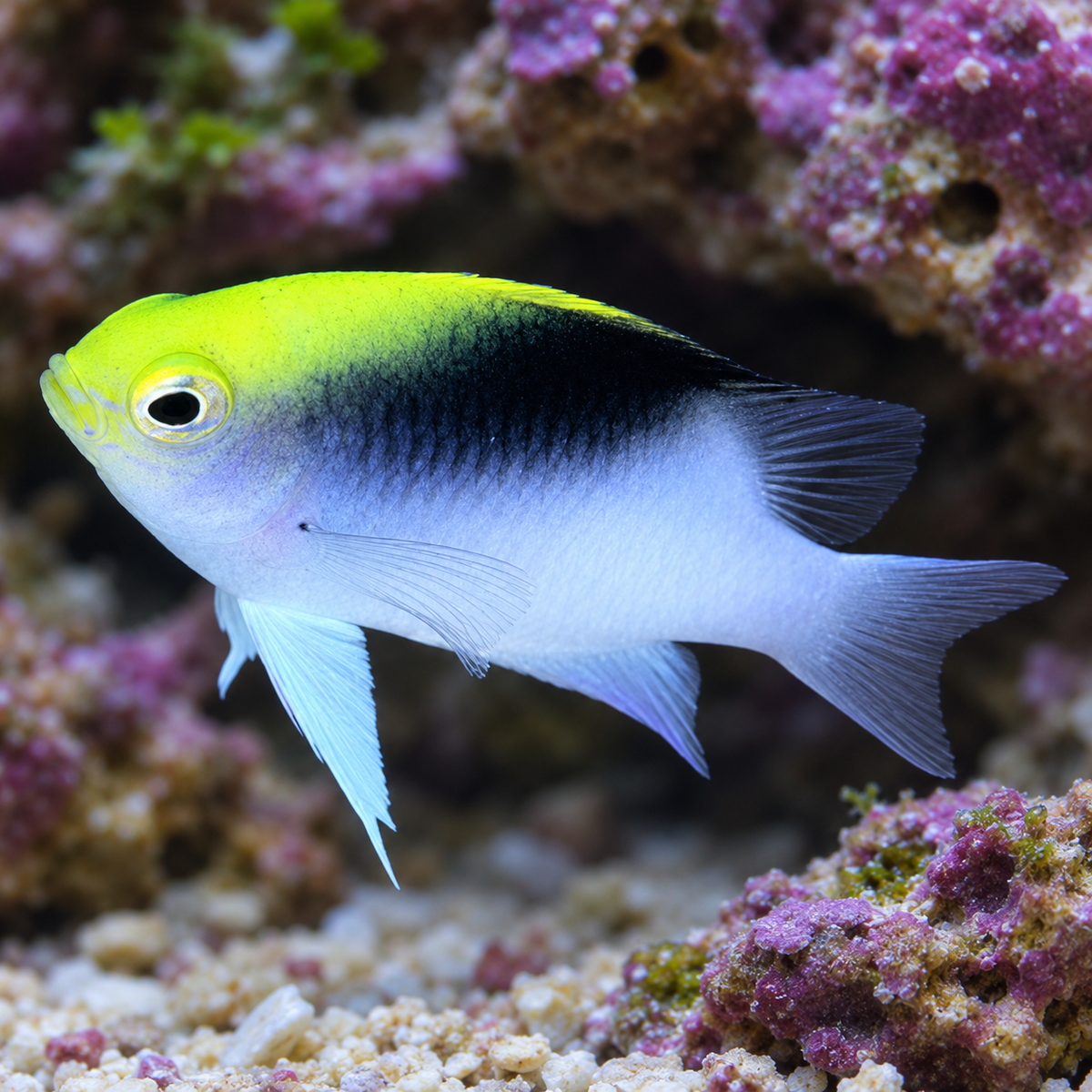
Add beautiful contrasting coloration and lively reef activity to your saltwater aquarium with the Rolland's Damselfish (Chrysiptera rollandi), also known as Rolland's Demoiselle or the Blackcap Damselfish. This attractive marine species is admired for its distinctive dark blue-gray head, lighter body coloration, and compact, graceful appearance. Its energetic swimming behavior and unusual color pattern make it an appealing addition to established saltwater aquariums, particularly for aquarists seeking a colorful alternative to more commonly maintained damselfish.
Native to tropical reef environments throughout the eastern Indian Ocean and western Pacific, Rolland's Damselfish inhabit lagoons, sheltered reefs, and rocky coral formations where they forage among protected reef structures. Compared with many other damselfish, this species is often relatively manageable in community aquariums, although individuals may become territorial as they mature. With appropriate tank mates, abundant hiding locations, and stable marine conditions, Rolland's Damselfish can be an excellent choice for carefully planned reef and fish-only saltwater aquariums.
At a Glance: Quick Species Facts
- Common Name: Rolland's Damselfish, Rolland's Demoiselle, Blackcap Damselfish
- Scientific Name: Chrysiptera rollandi
- Family: Pomacentridae
- Natural Distribution: Eastern Indian Ocean and Western Pacific Ocean
- Coloration: Dark Blue-Gray Head with a Pale Gray to Whitish Body
- Maximum Adult Size: Approximately 3 inches
- Recommended Minimum Aquarium Size: 30 gallons
- Care Level: Easy to Moderate
- Temperament: Generally Peaceful to Semi-Aggressive; May Become Territorial
- Diet: Omnivore
- Reef Compatibility: Generally Reef Safe
- Water Temperature: 72–78°F
- Specific Gravity: 1.023–1.026
- Recommended pH: 8.1–8.4
Characteristics
The Rolland's Damselfish is recognized for its beautiful two-tone coloration, compact body shape, and active swimming behavior. Its head and anterior dorsal region typically display darker blue-gray coloration, creating a striking contrast with the lighter gray or whitish portions of the body.
The species is sometimes called the Blackcap Damselfish because the darker coloration around its head and upper body resembles a contrasting cap.
Its laterally compressed body and relatively small size allow it to maneuver efficiently through coral branches, rocky crevices, and other protected reef structures.
Rolland's Damselfish possess a continuous dorsal fin, prominent eyes, and a streamlined body characteristic of many members of the damselfish family.
Individual fish may display subtle differences in color intensity, particularly around the head, dorsal region, and rear portions of the body.
In natural reef environments, Rolland's Damselfish commonly inhabit lagoons, sheltered reef areas, and outer reef slopes where they remain close to coral formations and protective rockwork.
Unlike species that spend most of their time swimming in large open-water schools, Rolland's Damselfish frequently remain associated with reef structures while exploring nearby swimming areas.
These fish are naturally alert and inquisitive, often investigating changes in their surroundings before returning to a preferred sheltered location.
Individual specimens may display natural variations in coloration, markings, body proportions, and temperament depending on maturity and environmental conditions.
Optimal Aquarium Conditions & Care Guide
Rolland's Damselfish require a stable, fully cycled saltwater aquarium with established biological filtration, abundant live rock, and numerous secure hiding locations. Although relatively adaptable, this species benefits from a mature marine environment that provides consistent water chemistry and appropriate territorial separation.
A minimum aquarium size of approximately 30 gallons is recommended for an individual, with larger aquariums offering additional swimming space and improved compatibility when maintained alongside other territorial marine fish.
Because Rolland's Damselfish may defend preferred hiding places as they mature, a thoughtfully arranged aquarium containing multiple caves, rocky structures, and sheltered retreats is especially beneficial.
Recommended Aquarium Setup
- Live Rock: Provide abundant established live rock with natural reef structures and opportunities for exploration.
- Hiding Places: Incorporate multiple caves, sheltered overhangs, and rocky crevices.
- Swimming Space: Maintain sufficient open areas for comfortable swimming while preserving protected territories.
- Water Movement: Provide moderate, well-distributed circulation with adequate oxygenation.
- Filtration: Maintain efficient biological and mechanical filtration to support excellent water quality.
- Substrate: Marine sand, aragonite, or crushed coral may be used to create a natural reef environment.
- Aquarium Maturity: Introduce this species into an established aquarium rather than an uncycled marine system.
- Environmental Stability: Avoid sudden changes in temperature, salinity, pH, and other water parameters.
In its natural habitat, Rolland's Damselfish occupy tropical lagoons and coral reef environments where rocky structures and coral formations provide shelter from predators.
Established live rock is particularly beneficial because it creates natural hiding areas and provides surfaces supporting beneficial biological growth.
Providing multiple separated rock formations allows the fish to establish a preferred territory without continuously competing with other aquarium inhabitants.
Rolland's Damselfish may initially remain close to rockwork when introduced into an unfamiliar aquarium. As they become comfortable, they often explore a larger portion of the surrounding environment.
Excellent oxygenation, stable water chemistry, and an established biological filtration system are important for maintaining long-term health.
Behavior and Tank Mates
Rolland's Damselfish are generally considered peaceful to moderately territorial marine fish. Compared with some highly aggressive damselfish species, they often display a more manageable temperament, although territorial disputes can still occur.
Appropriate tank mate selection is particularly important when maintaining this species in smaller aquariums or alongside other damselfish that may compete for similar hiding locations.
Potential Tank Mates
- Ocellaris and Percula Clownfish
- Cardinalfish
- Peaceful wrasses
- Gobies
- Blennies
- Royal Grammas in appropriately sized aquariums
- Peaceful firefish when sufficient shelter is available
- Other appropriately sized community reef fish
Compatibility depends on aquarium size, individual temperament, established territories, and available hiding locations.
Highly aggressive damselfish and dominant territorial species may intimidate Rolland's Damselfish or compete directly for preferred reef structures.
Extremely timid fish may also experience stress if housed with an unusually assertive individual.
Rolland's Damselfish may display territorial behavior toward members of their own species or other similarly shaped damselfish.
A single specimen is generally a practical choice for a smaller community marine aquarium. Maintaining multiple individuals requires additional space, abundant shelter, and careful observation of social interactions.
Providing several hiding locations and introducing new aquarium inhabitants thoughtfully can help reduce unnecessary territorial conflicts.
Reef Aquarium Compatibility
Rolland's Damselfish are generally considered reef safe. They are not typically associated with consuming healthy ornamental coral tissue and can be maintained in many established reef aquariums.
Commonly compatible reef inhabitants may include:
- Small-polyp stony corals (SPS)
- Large-polyp stony corals (LPS)
- Selected soft corals
- Zoanthids and colonial polyps
- Mushroom corals
- Appropriately sized ornamental snails
- Selected marine shrimp
- Other compatible reef invertebrates
Although Rolland's Damselfish generally coexist with ornamental corals, individual behavior should be monitored because compatibility can vary between aquarium environments.
Territorial individuals may occasionally chase other fish away from their preferred rock formations or sheltered reef areas.
Providing abundant rockwork and appropriate swimming space helps minimize competition and supports a more balanced reef environment.
Carefully observe interactions with both fish and invertebrates, particularly when introducing new animals into an established aquarium.
Diet and Feeding Requirements
Rolland's Damselfish are omnivorous marine fish that naturally consume small planktonic organisms and algae-based food sources. In their natural reef environments, they feed on planktonic crustaceans, small marine organisms, fish eggs, and available algae.
In captivity, Rolland's Damselfish generally accept a wide variety of appropriately sized frozen and commercially prepared marine aquarium foods.
A balanced diet combining high-quality marine proteins and suitable plant-based nutrients helps maintain healthy coloration, energy, and overall physical condition.
Recommended Foods
- Frozen mysis shrimp
- Vitamin-enriched brine shrimp
- Marine plankton preparations
- High-quality marine omnivore pellets
- Marine flake foods
- Spirulina-enriched marine foods
- Finely chopped marine shrimp
- Appropriate marine algae preparations
- Balanced frozen marine omnivore blends
Frozen mysis shrimp and other small marine crustaceans help replicate the species' natural consumption of planktonic animal-based foods.
Spirulina-enriched preparations and marine algae products can provide additional plant-based nutrients as part of a varied diet.
Rolland's Damselfish are generally active feeders that investigate food suspended in the water column and near reef structures.
Providing a varied, nutritionally balanced diet is important for maintaining vibrant coloration, healthy body condition, and long-term well-being. Aquarists should monitor feeding behavior and ensure all aquarium inhabitants have adequate access to food.
Appropriately sized foods are particularly important for smaller individuals, while excess uneaten food should be removed to maintain stable water quality.
Maintaining dietary variety supports natural feeding behavior and helps promote overall health in established marine aquariums.
Important Shipping & Acclimation Notes
Live Animal Notice: Rolland's Damselfish are living marine animals. Individual specimens may naturally vary in coloration, markings, size, and behavior.
The distinctive dark head and lighter body coloration may vary in intensity depending on maturity, individual development, lighting, and environmental conditions.
Transportation and handling may temporarily affect coloration, swimming activity, and appetite.
Newly arrived Rolland's Damselfish may initially remain hidden among rockwork or sheltered reef structures while adjusting to unfamiliar surroundings.
Although this species is generally hardy, sudden environmental changes can still cause significant stress.
Before introducing your fish, ensure your aquarium is fully cycled and maintains suitable temperature, salinity, oxygen levels, and overall water quality.
Inspect the fish upon arrival and follow the acclimation instructions provided with your shipment.
Avoid sudden changes in temperature or salinity and minimize unnecessary handling.
Provide secure hiding locations and a peaceful environment during the initial adjustment period.
Carefully monitor feeding acceptance, swimming behavior, and overall body condition after introduction.
Appropriate quarantine procedures and careful observation are recommended before introducing new marine fish into an established display aquarium.
Monitor interactions with established aquarium inhabitants, particularly highly territorial damselfish and aggressive marine fish.
With its distinctive dark-headed coloration, elegant two-tone appearance, and active reef-dwelling personality, Rolland's Damselfish is a captivating addition to established saltwater aquariums. For aquarists who provide stable water conditions, suitable tank mates, and abundant natural rockwork, this beautiful Indo-Pacific damselfish offers lasting visual appeal and engaging marine behavior.
-
Free Shipping
Orders $169 and over qualify for free overnight shipping. A $12.50 packaging fee applies. Destination rates and restrictions apply. Shipping details.