

SDC
Domino Damselfish (Three Spot Damsel)
Domino Damselfish (Three Spot Damsel)
Couldn't load pickup availability
Free overnight shipping at $169+. $12.50 packaging applies. Destination restrictions apply.
Shipping details Day-of-arrival claim requirements
Free Shipping*
Free Shipping*
Orders $169 and over qualify for free overnight shipping. A $12.50 packaging fee applies. Destination rates and restrictions apply. Shipping details.
Live Arrival Guaranteed
Live Arrival Guaranteed
Live arrival is covered on the day of arrival only. Email photos under 5MB to support@SaltwaterFishSale.com on that same day. For valid DOA claims, we offer a refund or store credit for the value of the fish within 5 business days. No videos or reshipments. Shipping is non-refundable. Additional proof is required for fish over $100. Full claim instructions.
The Domino Damselfish (Dascyllus trimaculatus) is a bold and distinctive saltwater aquarium fish recognized for its deep black coloration and contrasting white spots. Also known as the Three Spot Damselfish, this hardy marine species brings dramatic contrast, energetic swimming behavior, and unmistakable personality to appropriately stocked saltwater aquariums.
Native to tropical Indo-Pacific coral reefs, Domino Damselfish inhabit lagoons, sheltered reef environments, and areas containing branching corals and protective rock formations. Juveniles are particularly attractive because of their prominent white markings, while adults develop a more subdued appearance and increasingly territorial behavior. Although adaptable to aquarium conditions, this species is best suited for aquarists who understand the challenges of keeping assertive damselfish.
At a Glance: Quick Species Facts
- Common Name: Domino Damselfish
- Alternative Names: Three Spot Damselfish, Threespot Dascyllus, Three Spot Humbug
- Scientific Name: Dascyllus trimaculatus
- Family: Pomacentridae
- Origin: Indo-Pacific
- Natural Habitat: Coral reefs, lagoons, reef slopes, and sheltered rocky environments
- Care Level: Easy to Moderate
- Temperament: Aggressive and territorial, particularly as an adult
- Maximum Adult Size: Approximately 5–5.5 inches
- Minimum Aquarium Size: 75 gallons recommended for long-term adult housing
- Diet: Omnivore
- Reef Compatibility: Generally coral-safe; aggression toward other fish requires careful consideration
- Preferred Water Temperature: 74–80°F
- Specific Gravity: 1.023–1.025
- Preferred pH: 8.1–8.4
- Recommended Experience Level: Beginner to Intermediate, with appropriate stocking considerations
Characteristics
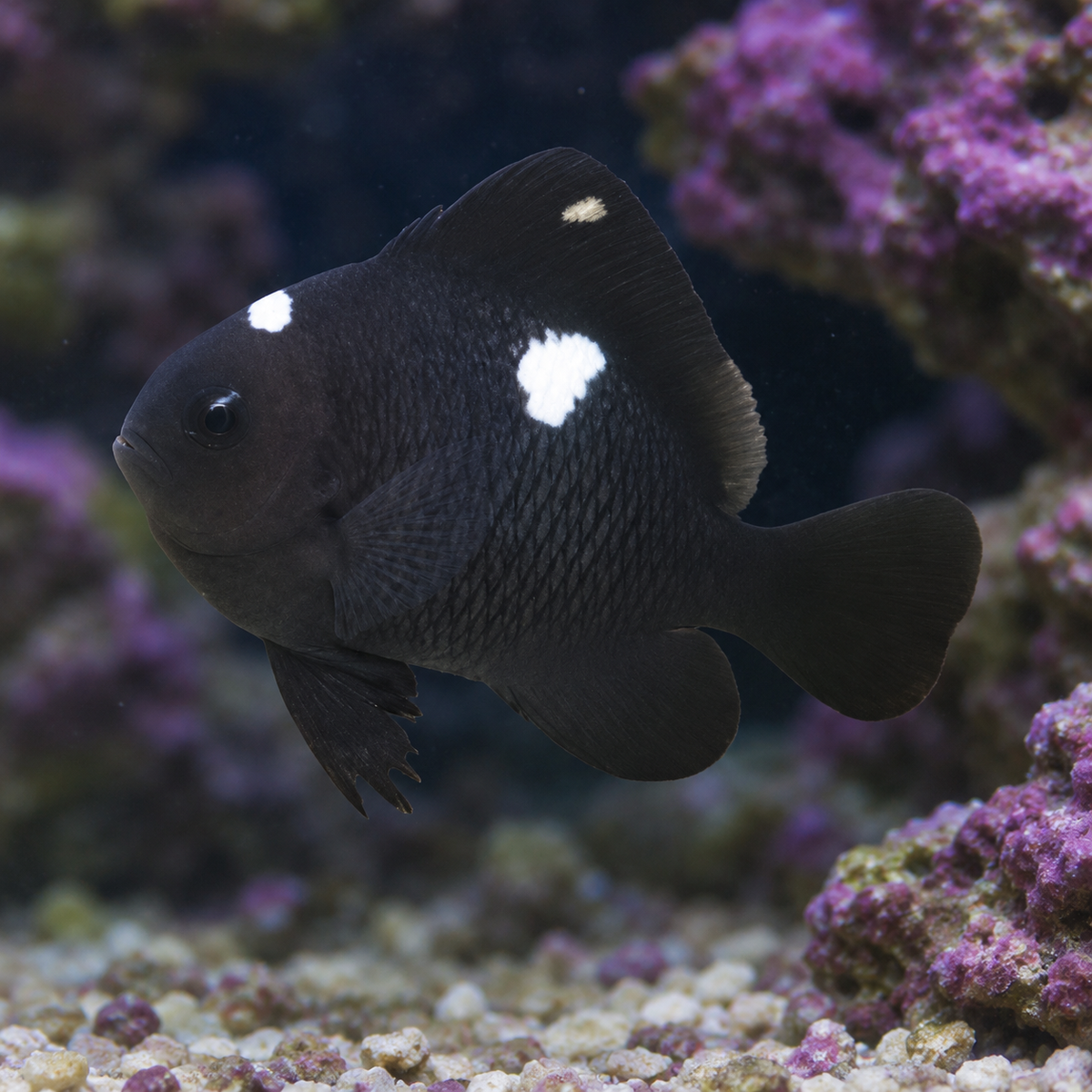
The Domino Damselfish earns its common name from the striking contrast between its dark body and bright white markings, creating an appearance reminiscent of a black domino tile.
Juvenile specimens typically display three prominent white spots: one positioned near the forehead and two located along the upper sides of the body. These markings stand out against the fish's predominantly black coloration and make young individuals especially recognizable.
As the fish matures, its coloration and markings may change considerably. The forehead spot often disappears, while the spots along the body may become smaller, less distinct, or nearly absent.
Adult Domino Damselfish commonly develop dark charcoal, brownish-black, or nearly black coloration. Individual appearance can vary depending on maturity, environmental conditions, and natural pigmentation.
This species has a deep, laterally compressed body with rounded contours and substantial dorsal and anal fins. Its compact but sturdy build helps it navigate coral structures and defend positions within the reef.
Domino Damselfish are active swimmers that frequently move between exposed swimming areas and protective rock formations. Their movement can be especially engaging in an aquarium with an open front viewing area and complex rockwork.
In natural environments, juveniles may associate with sea anemones, branching corals, or long-spined sea urchins that provide protection from larger predators. These associations are interesting examples of the species' adaptable shelter-seeking behavior.
One of the most important characteristics of this fish is its changing temperament. A small juvenile may initially appear relatively peaceful, but an established adult can become highly possessive of its territory and aggressively defend it against other fish.
Optimal Aquarium Conditions & Care Guide
The Domino Damselfish is a hardy and adaptable marine species that can thrive in a well-maintained aquarium with stable water parameters, efficient filtration, and adequate swimming space. Its resilience makes it relatively straightforward to care for physically, although its territorial behavior can complicate community aquarium management.
A minimum aquarium size of 75 gallons is recommended for long-term adult housing, particularly when the fish will share its environment with other saltwater species. Larger aquariums provide more opportunities to establish separate territories and reduce constant encounters between competing fish.
Provide a natural-looking marine environment containing established live rock, multiple hiding places, and open water for swimming. The layout should accommodate both the fish's need for shelter and its tendency to defend specific areas.
Recommended Aquarium Setup
- Live Rock: Include stable rock structures that resemble natural reef habitat and provide territorial boundaries.
- Hiding Places: Offer caves, overhangs, crevices, and sheltered areas throughout the aquarium.
- Swimming Space: Maintain clear swimming areas around and between the rock formations.
- Water Movement: Provide moderate, varied circulation appropriate for a tropical marine reef environment.
- Filtration: Use efficient biological and mechanical filtration to maintain consistently good water quality.
- Substrate: Marine sand or crushed coral can be used according to the overall aquarium design.
- Aquarium Maturity: Introduce the fish only after the biological filtration system is established and water parameters are stable.
- Environmental Stability: Avoid sudden changes in temperature, salinity, pH, and other important water conditions.
Ammonia and nitrite should remain undetectable in an established aquarium. Regular testing and appropriate maintenance help prevent water quality problems that can affect the health and behavior of marine fish.
Rockwork should be securely arranged because the fish may swim rapidly through narrow spaces or retreat suddenly when startled. Stable structures also reduce the risk of displaced decorations.
Although Domino Damselfish can adapt to different aquarium layouts, an environment with multiple visually separated territories is preferable to one containing a single dominant rock structure.
It is important to consider the fish's adult size and behavior before adding it to a smaller established aquarium. A juvenile's current size does not accurately represent the space or compatibility requirements it may develop with maturity.
When introducing a Domino Damselfish to an established aquarium, evaluate the current occupants carefully. Adding an aggressive species can significantly change the social balance of a previously peaceful marine community.
Behavior and Tank Mates
The Domino Damselfish has an assertive, territorial temperament that often intensifies with age. Young specimens may coexist in loose groups under some conditions, but adults can aggressively defend caves, coral heads, and established sections of the aquarium.
This species is generally better suited to carefully planned semi-aggressive or aggressive marine communities than to peaceful aquariums containing timid fish. Aquarium size, rockwork, stocking order, and individual temperament all influence compatibility.
Potential Tank Mates
- Robust larger clownfish species
- Selected similarly assertive damselfish
- Peaceful-to-moderately assertive tangs in suitably sized aquariums
- Hardy dwarf angelfish with adequate territorial space
- Appropriately sized larger angelfish
- Selected robust wrasses
- Suitable rabbitfish in larger marine aquariums
- Other comparably sized, confident marine fish with compatible care requirements
Compatibility with these groups is not guaranteed. Individual behavior and available swimming space must always be considered before introducing additional fish.
Domino Damselfish may chase, intimidate, or repeatedly displace smaller fish that enter their territory. This behavior can be particularly problematic for timid gobies, small blennies, and other species that depend on undisturbed shelter.
Housing multiple Domino Damselfish together requires careful planning. Although juveniles can sometimes coexist, aggression may increase as individuals mature and establish dominance relationships.
Maintaining several specimens in a confined aquarium can result in persistent chasing and uneven access to food or shelter. Additional fish should never be introduced solely under the assumption that members of the same species will naturally remain compatible.
Adding a Domino Damselfish after more peaceful species have established themselves may sometimes reduce its initial territorial advantage, but stocking order alone cannot prevent future aggression.
Rearranging rockwork can occasionally disrupt established territories when compatibility problems arise. However, severe or persistent aggression may require separating incompatible animals.
Because adult Domino Damselfish can be difficult to capture in aquariums containing extensive rockwork, long-term compatibility should be considered before purchase rather than after territorial problems develop.
Reef Aquarium Compatibility
Domino Damselfish are generally considered reef-safe with respect to corals and most common ornamental reef invertebrates. Their primary compatibility concern is aggression toward other fish rather than a tendency to consume healthy coral tissue.
Potentially compatible reef inhabitants include:
- Soft corals
- Leather corals
- Mushroom corals
- Zoanthids and palythoas
- Large-polyp stony corals
- Small-polyp stony corals
- Appropriately sized ornamental shrimp
- Marine snails, hermit crabs, and other suitable cleanup crew members
As with any reef aquarium, individual animal behavior should be observed. A fish that is generally coral-safe can still disturb nearby organisms while defending territory or pursuing tank mates.
Domino Damselfish may establish territories around prominent coral colonies or rock formations. This can make it difficult for timid fish to occupy nearby areas even when the coral itself remains unharmed.
A spacious reef aquarium with multiple hiding places and well-distributed rock formations can help reduce repeated encounters between the damselfish and other inhabitants.
Reef compatibility should be evaluated as a combination of coral safety, invertebrate safety, and fish-to-fish aggression. A species may be suitable around corals while still being a poor choice for a peaceful reef community.
Diet and Feeding Requirements
The Domino Damselfish is an omnivorous marine fish that benefits from a varied diet combining animal-based foods and appropriate plant-derived nutrition. In natural reef environments, it consumes small planktonic organisms and other available food particles.
In aquariums, this species generally accepts a broad selection of prepared and frozen marine foods. A diverse diet helps support healthy growth, condition, and coloration throughout its development.
Food items should be appropriately sized for the individual fish and selected for their nutritional quality. Marine-specific preparations are preferable to relying exclusively on a single food type.
Recommended Foods
- High-quality marine omnivore pellets
- Premium marine flake foods
- Frozen mysis shrimp
- Vitamin-enriched brine shrimp
- Finely chopped marine shrimp
- Finely chopped clam
- Finely chopped squid
- Marine plankton-based preparations
- Spirulina-enriched marine foods
Mysis shrimp and other suitable marine proteins provide valuable nutritional variety, while quality prepared foods help deliver a broader balance of nutrients.
Spirulina-based foods and other marine formulations containing plant-derived ingredients can complement the animal-based portion of the diet.
Very young specimens may require smaller food particles than fully grown adults. Choosing appropriately sized foods allows the fish to consume them efficiently.
Because Domino Damselfish are assertive swimmers, they may compete vigorously during feeding. In a community aquarium, observe whether quieter tank mates have adequate opportunities to access food.
Dietary variety, appropriate portion sizes, and consistently good water quality are essential components of long-term nutritional care.
Remove uneaten food when necessary to prevent unnecessary nutrient accumulation and maintain a healthy marine environment.
Important Shipping & Acclimation Notes
Live Animal Notice: Domino Damselfish are living marine animals, and each specimen may vary naturally in coloration, size, white spot visibility, and overall appearance.
Juvenile fish generally display more prominent white spots than mature adults. These markings may fade or change as the animal develops.
Transport can temporarily affect a fish's coloration, activity level, and willingness to explore its surroundings.
Some specimens may appear darker, lighter, or less vividly marked immediately after arrival because of transportation-related stress.
It is normal for a newly introduced Domino Damselfish to spend time hiding among rocks or remaining close to shelter while adjusting to an unfamiliar aquarium.
Prepare a fully cycled saltwater aquarium with stable temperature, salinity, and water chemistry before the animal arrives.
Follow the acclimation instructions provided with your shipment and take care to avoid abrupt changes in environmental conditions.
Maintain suitable water movement and access to protected hiding spaces during the adjustment period.
Use caution when introducing a new specimen to an aquarium containing established territorial fish.
Likewise, consider the potential effect of a newly introduced Domino Damselfish on smaller or less assertive aquarium residents.
Observe the fish after introduction for signs of persistent aggression, physical injury, unusual breathing, or difficulty accessing shelter.
New marine fish should be monitored carefully, and an appropriate quarantine procedure is recommended whenever practical.
Continued observation of appetite, swimming behavior, body condition, and interactions with tank mates can help identify potential husbandry concerns early.
With its unmistakable black-and-white juvenile markings, energetic swimming style, and hardy nature, the Domino Damselfish is a memorable addition to a properly planned marine aquarium where its territorial adult temperament can be accommodated.
-
Free Shipping
Orders $169 and over qualify for free overnight shipping. A $12.50 packaging fee applies. Destination rates and restrictions apply. Shipping details.