

SDC
Glass Cardinalfish
Glass Cardinalfish
Couldn't load pickup availability
Free overnight shipping at $169+. $12.50 packaging applies. Destination restrictions apply.
Shipping details Day-of-arrival claim requirements
Free Shipping*
Free Shipping*
Orders $169 and over qualify for free overnight shipping. A $12.50 packaging fee applies. Destination rates and restrictions apply. Shipping details.
Live Arrival Guaranteed
Live Arrival Guaranteed
Live arrival is covered on the day of arrival only. Email photos under 5MB to support@SaltwaterFishSale.com on that same day. For valid DOA claims, we offer a refund or store credit for the value of the fish within 5 business days. No videos or reshipments. Shipping is non-refundable. Additional proof is required for fish over $100. Full claim instructions.
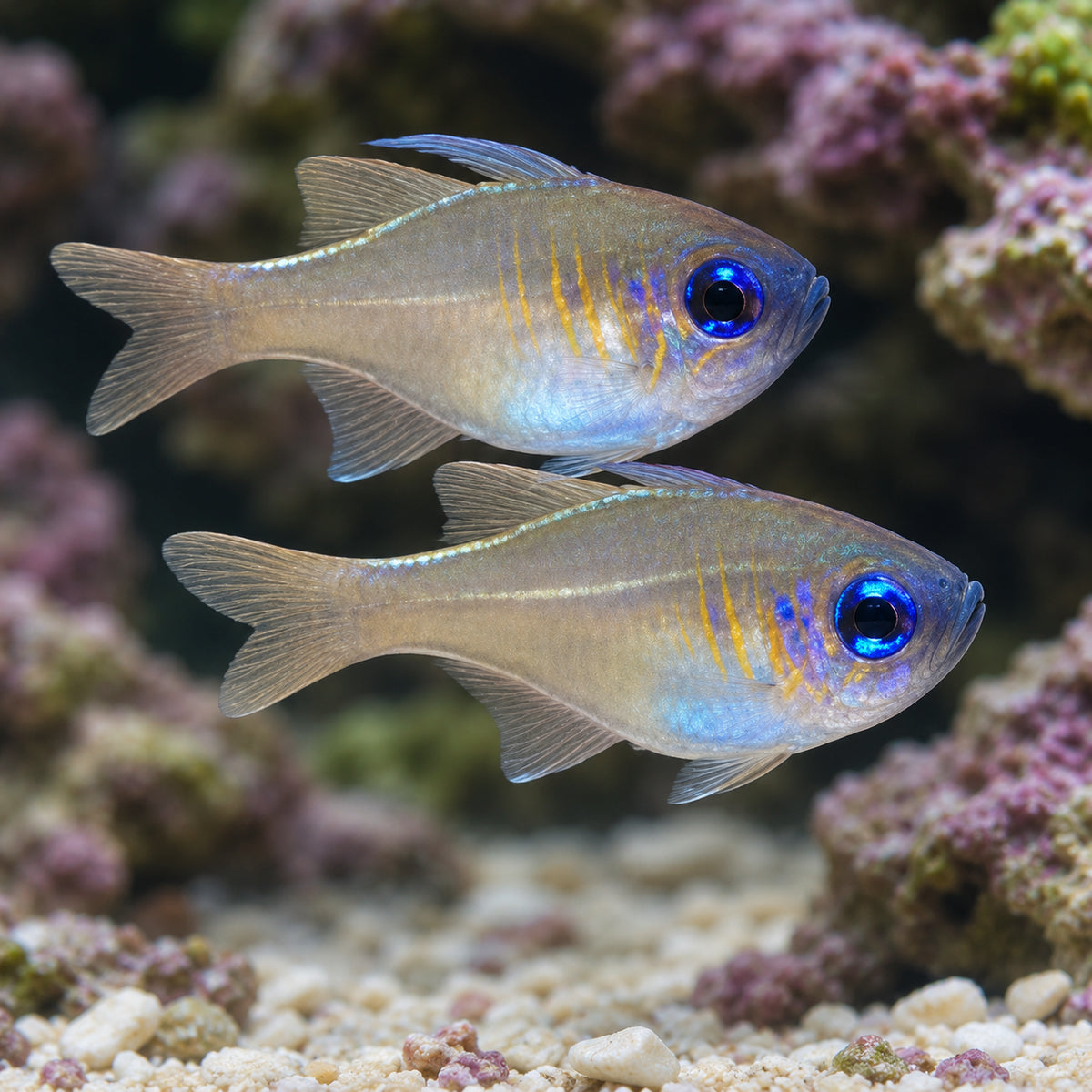
Add subtle elegance and beautiful schooling behavior to your saltwater aquarium with the Glass Cardinalfish (Zoramia leptacantha). Also known as the Threadfin Cardinalfish or Longspine Cardinalfish, this delicate marine species is admired for its translucent silver body, subtle blue and yellow accents, and graceful swimming movements.
Unlike brightly colored marine fish that immediately dominate an aquarium display, Glass Cardinalfish create visual interest through their delicate appearance and natural group behavior. Their semi-transparent bodies reflect aquarium lighting beautifully, producing a shimmering effect as they move through the water.
Native to tropical Indo-Pacific reef environments, Glass Cardinalfish are peaceful marine fish that can make attractive additions to established reef and community saltwater aquariums. They are particularly appealing when maintained in compatible groups with adequate space and suitable shelter.
At a Glance: Quick Species Facts
- Common Name: Glass Cardinalfish
- Other Common Names: Threadfin Cardinalfish, Longspine Cardinalfish
- Scientific Name: Zoramia leptacantha
- Former Scientific Name: Apogon leptacanthus
- Family: Apogonidae
- Natural Distribution: Indo-Pacific Ocean
- Maximum Adult Size: Approximately 2.5 inches
- Recommended Minimum Aquarium Size: 30 gallons
- Care Level: Easy to Moderate
- Temperament: Peaceful
- Diet: Carnivore
- Reef Compatibility: Reef Safe
- Social Behavior: Naturally Group-Oriented
- Water Temperature: 74–80°F
- Specific Gravity: 1.023–1.026
- Recommended pH: 8.1–8.4
Characteristics
The Glass Cardinalfish is recognized for its semi-transparent body, delicate fins, and understated coloration.
Its translucent silver body allows portions of its internal structures to be faintly visible, giving the fish the glass-like appearance responsible for its common name.
Subtle blue and yellow coloration may appear around the head and body, creating an attractive contrast against its otherwise pale appearance.
The species possesses elongated fin rays that contribute to its delicate silhouette and graceful swimming movements.
Glass Cardinalfish typically remain relatively small throughout their lives, making them suitable for appropriately stocked marine community aquariums.
One of their most appealing characteristics is their natural tendency to gather in groups. When maintained with compatible individuals, these fish may hover together near sheltered reef structures.
Their coordinated movements can create an attractive display, particularly in aquariums featuring natural live rock formations and open areas.
Like many cardinalfish, Glass Cardinalfish may become more active during periods of reduced lighting.
The combination of translucent coloration, small adult size, and calm swimming behavior makes this species an interesting addition to a peaceful marine aquarium.
Optimal Aquarium Conditions & Care Guide
Glass Cardinalfish thrive in a stable, established saltwater aquarium with appropriate shelter, gentle swimming areas, and consistent marine water parameters.
A minimum aquarium size of approximately 30 gallons is recommended, with larger aquariums providing additional space for groups and compatible marine community fish.
Because this species often congregates near shelter, aquarium layout should provide a combination of protected areas and unobstructed swimming space.
Recommended Aquarium Setup
- Live Rock: Provide established live rock formations with natural hiding locations.
- Hiding Places: Incorporate caves, overhangs, and sheltered areas where fish can retreat.
- Swimming Space: Maintain open areas near rockwork for natural group movement.
- Water Movement: Provide moderate, well-distributed circulation with calmer resting areas.
- Filtration: Maintain effective biological and mechanical filtration.
- Substrate: Marine sand or crushed coral may be used in a suitable saltwater aquarium.
- Aquarium Stability: Maintain consistent temperature, salinity, pH, and overall water quality.
Glass Cardinalfish are commonly associated with coral-rich environments and sheltered reef habitats.
Although they naturally seek protection near reef structures, a particular coral species is not required for successful aquarium care.
Aquariums containing established live rock, appropriate shelter, and compatible tank mates can provide a suitable environment.
Because their bodies are relatively small and delicate, avoid placing Glass Cardinalfish in environments dominated by highly aggressive or predatory marine fish.
Maintaining stable water conditions and minimizing unnecessary stress are important for long-term health.
Behavior and Tank Mates
The Glass Cardinalfish is generally considered a peaceful marine community species that can coexist with many appropriately sized, non-aggressive saltwater fish.
Unlike certain cardinalfish species that become strongly territorial toward one another, Glass Cardinalfish naturally occur in groups and are often maintained together in marine aquariums.
Group size should be appropriate for the aquarium's dimensions, filtration capacity, and existing livestock.
In suitable conditions, multiple individuals may remain near one another, creating an attractive display of subtle, coordinated movement.
Potential Tank Mates
- Peaceful clownfish
- Small gobies
- Compatible blennies
- Firefish
- Peaceful fairy wrasses
- Other compatible cardinalfish
- Appropriately sized peaceful marine community fish
Compatibility depends on aquarium size, individual temperament, and the amount of available shelter.
Avoid large predatory fish and aggressive species that may intimidate or consume smaller cardinalfish.
Highly competitive tank mates can also interfere with feeding, particularly when Glass Cardinalfish are newly introduced.
Reef Aquarium Compatibility
Glass Cardinalfish are considered reef safe.
They do not normally consume healthy coral tissue and are generally compatible with established reef aquarium environments.
Their small size and peaceful behavior make them suitable companions for many ornamental corals and appropriately selected marine invertebrates.
As with all aquarium livestock, compatibility with very small ornamental crustaceans should be considered because Glass Cardinalfish naturally consume small animal prey.
Their subtle coloration can be especially attractive against natural live rock and coral backgrounds.
Diet and Feeding Requirements
The Glass Cardinalfish is a carnivorous marine fish that naturally consumes small planktonic crustaceans and other appropriately sized marine organisms.
In captivity, a varied diet containing high-quality marine proteins helps support healthy growth, body condition, and overall well-being.
Because these fish have relatively small bodies, appropriately sized foods are important.
Recommended Foods
- Frozen mysis shrimp
- Enriched marine brine shrimp
- Small marine plankton preparations
- Finely chopped marine shrimp
- Appropriately sized frozen carnivore blends
- Small marine pellets when accepted
- Other suitable marine crustacean-based foods
Some Glass Cardinalfish may initially be cautious when approaching unfamiliar foods.
Offering appropriately sized marine foods in areas where the fish feel secure can help encourage natural feeding behavior.
Monitor individual fish to ensure that more aggressive or faster-swimming tank mates are not preventing them from obtaining food.
A balanced marine diet helps maintain healthy body condition and supports long-term aquarium care.
Important Shipping & Acclimation Notes
Live Animal Notice: The Glass Cardinalfish is a living marine animal. Individual specimens may naturally vary in size, coloration, transparency, and behavior.
Transportation and handling can temporarily influence coloration, swimming activity, and feeding responses.
Newly arrived Glass Cardinalfish may initially seek shelter or remain near protected aquarium structures while adjusting to unfamiliar surroundings.
Before introducing your fish, ensure your aquarium is established and maintains suitable temperature, salinity, pH, and overall water quality.
Inspect your fish upon arrival and follow the acclimation instructions provided with your shipment.
Avoid sudden environmental changes and unnecessary handling.
Provide appropriate hiding places and a calm environment during the initial adjustment period.
When introducing multiple Glass Cardinalfish, monitor group interactions and ensure that individuals have sufficient space and access to food.
Observe swimming behavior and feeding responses as the fish becomes accustomed to its surroundings.
With its delicate translucent body, subtle iridescent accents, and graceful group behavior, the Glass Cardinalfish makes an elegant addition to a well-maintained saltwater or reef aquarium.
-
Free Shipping
Orders $169 and over qualify for free overnight shipping. A $12.50 packaging fee applies. Destination rates and restrictions apply. Shipping details.